
Episode transcript
Mudit
Hi Julius, how are you doing?
Julius
I'm good, Mudith. How are you?
Mudit
I'm okay. I'm okay. How's the weather? Weather has been changing quite a lot in the recent past.
Julius
Yeah, yeah, yeah. It's it's bit cold, and weather in housing market is also a bit different now. Housing market, turbulent, but it may change soon.
Mudit
No, no, absolutely. See, I think absolutely bang on. So we know that we, as a country, Australia, needs more homes, right? There is no doubt about it. When we need more homes, that means there is demand. So why are the builders struggling? I think that's a question that is a very, very important question that we need to answer. And if we look at our population, in we've reached 27 point 8 million, and roughly 400,000 people were got added in one year, out of which 300,000 came as migrants. Right now, if we look at and in the same time, more than 200,000 dwellings were approved, which is which is 9% higher than the last year, the year before. So, which is phenomenally higher? Now, when we are when the population is going up and we are approving homes, then what's the problem? Why does housing still feel so scared? Why why are the builders struggling? I think that's something that we need to answer. We need to figure out that if if the approvals are higher, then maybe approval is not the problem. Then what is the problem? Delivery is
Julius
yeah. So I think the the largest issue is the delivery. So, if you look at the entire construction cycle, what we could see is we need to find out: Are we, if we are approving more homes, are we building enough? So, like last year, we say okay, there are like more than 205,000 approval in last financial years, but in March quarter, the only turnaround was around 43,800 dwellings were completed. So, because when you look at the when you map the entire housing journey, right? So, first of all, you get new population. When you get new people coming in, they need more houses. So, according to that council plan, and then they release more land. So, land release, the pre-sin planning is the second phase of that. Once the prison plant is done, then what they do is basically according to the requirements, developer requirements, how many people will move there, and then according so they they release the big piece of land called master plan community, and then there the approval process started. Okay, so the one big developer come in and then look, start looking for approvals. Okay, for an example, I'm big developer. I can accommodate around 500 homes. Then in stages, they go with the approvals. Like first release is probably around 50 homes. So once that approval is in there, then basically we'll go. They go with the finances. That's a more crucial stage where okay okay out of that 100 homes how many homes are booked around 70 80% is already pre-booked now they'll go with the finance and then according to this current financial structure with their books the risk bank assess them and banks if they finance once that is approved in preliminary then they go with the building approvals and then it one it goes to the builders, and then it from the builder it goes to the construction phase. So once it will go to the construction phase, that's the biggest cycle which takes around you know from approval to the construction would be the bigger window. It may last from around eight months to few years, depends on the capacity of that builder. Then you have the completion phase and then the occupation, so the entire cycle looks okay. Okay, the people comes and we got the homes, but in between there is a big logistic chain. And that
Mudit
chain itself, if there's one link which is weak in the chain, if there's any delay in one phase, it can cause a lot of problems in the overall cycle and the completion of the home itself.
Julius
So yeah, so each each each component of the chain is important, so we start find out what's happening in the construction industry. No, no,
Mudit
absolutely right. Because see, if we look at overall, because there is demand, but overall, if we look at last, let's say the last year itself, right, roughly 3600 construction companies down under. So if if there is, we are saying that if there is this whole cycle of starting from where the land gets released up to the construction, construction yeah, and if there are a lot of construction companies, 3600 companies going down in one year, that is roughly like eight to 10 companies every day. Now that's massive. That's that's more than quarter of all the companies going down in one financial year, so there is some problem there. There is a big there is a big issue which is which is which is causing this, and and we need to see that why are the builders struggling? What is because it it it is not possible that despite so much of demand, the whole industry is struggling in that way. It is
Julius
multiple indicators, right? Like for an example, the labor shortage and the cost. So at this stage, according to the master builders' estimation for this financial year, they were expecting around half a million workforce, but they didn't match the target. So sudden, so you have so many homes to build. There are a lot of big projects happening, infrastructure projects happening, in country. Where driven by the federal and a lot of workforce has been involved into those bigger infrastructure projects. You need more people. You have an immigration red tape. People are not coming. There is no skilled workforce, so that's why there is a labor shortage. Those who are available asking for more money because they know that there is a shortage. So that is the biggest problem. Second thing is the material cost. I still remember in 2021, what whatever you spend to build house, if you want to build now, it's around 40 to 50 percent more.
Mudit
Yep. Yeah. That's because
Julius
of the fuel crisis, logistics, and all the stuff. So basically, the material cost is expensive. It is. So those were built. The third is basically your interest rates, the borrowing cost. So those were planned for from 2024 or 23. Your interest for around three to 4% If we have locked those rates at 2000 in 2023 24, the construction is around one to two years project. In between, we have so many variables into the interest rates.
Mudit
Absolutely, interest rates. You, I mean, in the last couple of years, I mean, a lot of people had not planned for the kind of rises that have happened in the interest rates recently, right? And it was it was a big surprise. So, if people, including whether people like us or builders who have or businesses who have built their whole cash flow or projections around certain interest rate and certain suddenly you find that the interest rate has gone up by 1% Yeah, that is a killer because not a lot of businesses operate at very high margins. Some of these operated thin margins. So the moment interest rates, financing costs, because all a lot of this is uncollateralized debt. A lot of that is based. The interest rate is already a bit higher because they a lot of private financing goes in, and when the interest rates from the RBAs also go up as a as a cash rate itself, then it results in a bigger problem for the so money
Julius
money borrowing money become more expensive.
Mudit
Absolutely,
Julius
yeah. Then the cash flow crunches because your borrowing money is expensive, material cost is expensive. Suppose if I started the project in 2023, I would have estimated with around 4% or four and a half percent interest rate. My logistics for around 30% by the time I deliver, because in between you have approval, in between you have skill shortages, in in between you have weather challenges. So basically, every project gets delayed by six to eight months, and in between that there are so many variables like interest rates, your skill shortages, wages, and all the stuff. Then the biggest issue is whatever they are planned for, because most of the builders are running on margin of around 25 to 30% Then the margins are thinner over the time because that entire environment was so turbulent. So that's why cash flow was biggest issue.
Mudit
No, absolutely right. And and like a lot of other businesses, I think people people talk a lot about profit, which is of course every business is for profit. But what kills most businesses is not less profit, but it's the cash flow. Can you manage the cash flow? Because especially in construction industries, you have to incur costs upfront. A lot of times, when you're doing off the plan properties, you you take up the project, you incur cost. The the revenue you get ultimately is when the project gets completed. So you're incurring cost, but you're so you you're building the business. You you're creating, you're investing, investing, investing, doing those expenses, in in in the and and you expect that the revenue will come in future. So your cash flow, if if cash flow becomes crunched, that's when it becomes very difficult to sustain it for a long time. That's one of the bigger ones. The another one is the the government duties, levies. These are again extra costs in costs in the process, not extra costs, but they are there. These are fixed costs. So your fixed costs are there. Suddenly, if there is anything which happens, you cannot control all the fixed costs. You have equipment planned. You have duties to pay. That creates a problem for them.
Julius
Fixed price contracts. Oh yes, that is one of the reason. Because if suppose if I would have built a home for $500,000, so if my contract was signed in 2023 or 24 for $500,000. By the time I come, my project started, and then if I'm middle of the project, and then there'll be time. Okay, there are so many interest rate hikes. Logistics is expensive. Material cost is expensive. Probably builders send that variation. So one time they send a variation of 10% Probably the end consumer will absorb. But there are so many delays, and again they need more money. Sometimes they can't claim it, so either they have to absorb that loss and deliver the project,
Mudit
or they have to pass it on to the consumer, which may not be possible every time.
Julius
Exactly, exactly. So that that's that's the that's the biggest issue. The cash flow is a silent killer in this case.
Mudit
So costs keep going up at time, and your margins disappear, and if your revenue is not coming in at the time, it becomes a problem. Yeah, and and and absolutely right because because the way our construction industry is struggling, I think this is one of the bigger reasons because a lot of a lot of businesses. Especially in in in this industry, a lot of builders rely on churn because they are high volume, low margin businesses. Especially the bigger, scalable builders who are like hundreds of homes or properties and 1000s of under construction. So money has to keep flowing for them. The churn is critical. Yeah. Now, so if I have I have projected my cash flows that okay, I'm I'm going to complete this project after the completion in let's say X month I'll get so much money so based on that I invest in some other project I take up another project and invest the money there right now mostly even if the projects are there's pre-sales of 70% 80% but that means only five 10% of money would have come up front yeah most of the revenue for them will be realized only once the project gets completed. So the costs, including in labor, raw material, levies, debts, financing, everything keeps incurring, but the revenue gets, which is at the end. And what has happened is, I think sudden change in market dynamics creates some of the pressure. Now suddenly, if some builders were expecting that they were they'll be able to sell homes, but suddenly if the market becomes soft, which is what has happened recently because of that legislation changes, suddenly the market has become soft. Now you were expecting, let's say, if you were expecting these 100 houses will be sold for let's for let's say $1.5 million each, and now in the market you're not getting even 1.3 million dollars. First of all, the demand has softened, so not all the homes are selling. Plus, if they're selling, they're selling at a 10 percent, 15 percent discount. So your margin, which was already thin, goes for a toss.
Julius
Yeah. So for these big scale builders, right? The the biggest issue is not the profitability. Profitability is always there. The biggest issue is the cash flow, because when you have so much of sales volume, every quarter you need to make that numbers, and then that much of revenue has to be generated, which can be added to fund the next project, because it's a big cycle, which is running, and that's how they fund the entire project, and then this entire cycle moves smoothly. The biggest issue is when this type of tax changes or the recent changes which has happened, they actually break that cycle. When you have a sudden break into that cycle, that means your main money-making machine, which is your sales cycle, is disrupted, which is actually causing a lot of issues on your revenue. That's why when you look at the builder, like for them, it's not about profitability is issue. It's about because of these policies, we see okay they are not able to sell many homes which they were supposed to, which they were planned for, because there are a lot of other pipe projects in the pipeline which they have to fund for, so that cash flow becomes the biggest issue,
Mudit
and and you said I mean it's it's very important to understand specifically Bartla because out of all the builders now Bartla is works in a very specific category which is it was the best placed
Julius
yes to
Mudit
tie it through this because government is exactly funding and that's where Bartla was the government is not funding. Government is promoting, right? So affordable homes,
Julius
yeah.
Mudit
New pro new homes,
Julius
yeah.
Mudit
And that's exactly where Butler was. Affordable homes, new homes. That's exactly the market segment that it was focusing on, and that too in a very very high demand area. You talk about West Sydney, North West Sydney, North Sydney. That's where they had a huge amount of projects going on. Now, despite the government push and demand, pushing the demand towards new built and affordable properties, and a lot of marketing around it, and a lot of hype around it, still, if a builder like Bartla can go down, that exposes the whole the whole industry.
Mudit
it died because of two reasons: the changed policy, which actually was supposed to push more and more demand in this segment, but did it really push the demand in this segment, or did it just kill the demand? And second, of course, the cash flow because of that.
Julius
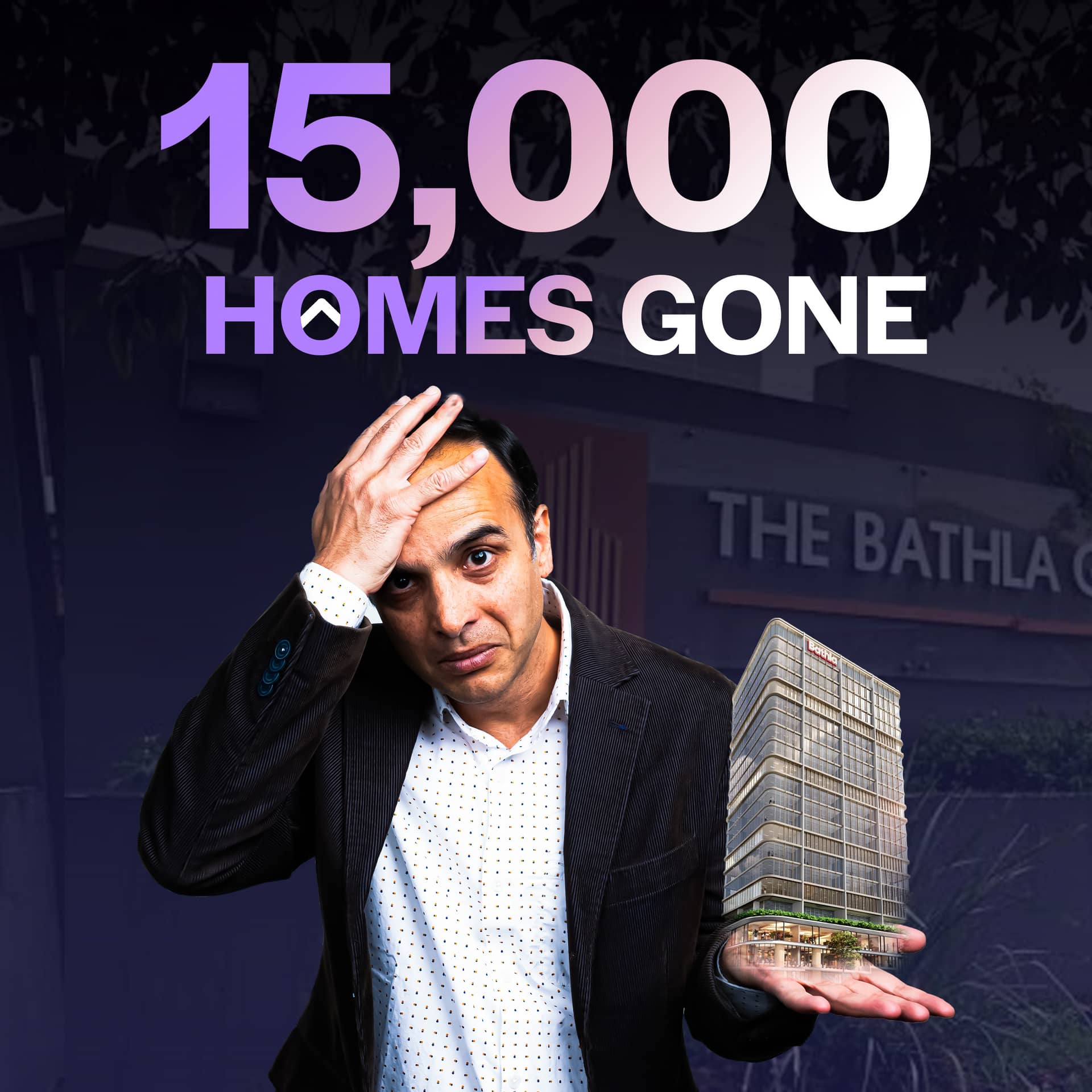
Yeah, it disrupted the entire sales volume, entire sales cycle, and that was the biggest issue. So they had around 15,000 homes under construction.
Mudit
15,000.
Julius
15,000. So now, what happened to that? Those who are supposed to deliver, it's like a project can be approved, buyer can always sign a contract, finance can be arranged, land can be developed, but ultimately somebody has to build the house.
Mudit
Yep,
Julius
and that's that's the biggest issue.
Mudit
No, absolutely right. See, and and this kind of impact when you have so many houses under construction, and it suddenly has a big impact on not only that that builder itself, but on the entire ecosystem, right? Yeah. You have buyers, you have subcontractors, suppliers, employees, financiers, developers. Everybody depends on these projects, there is such a large ecosystem. Everybody gets impacted.
Julius
Yeah, and those subcontractors, right? They are only not working with Batla; they are working with others as well. Since their businesses had lot of issues because they are not getting cash out from the one impacted project, they are not able to deliver to the other projects as well.
Mudit
No, absolutely right, and. When you talk about because Barda was operating in this West Sydney, North Northwest Sydney area, if you talk about that, those those those geographies, there's a huge population growth which is happening. If you talk about let's say Box Hill Nelson area, there's the population grew by roughly 17 percent in in one last last year in one year itself. Similarly, Austral population grew by almost 16 percent. Marsden Park, Shane's Park area, where Butler was again again very active, 12 percent population growth in one year. So we are saying that these areas are not areas where there is no demand. There is huge demand. Yeah. And despite that, a builder going down clearly underscores the structural problems in the industry. Exactly.
Julius
It's been highlighted by Samit Homeso as well in WA. So they actually they were asking government to remove the red tape on the immigration because I believe I don't remember the number, but there are so many skilled workers were stuck in Philippines and they want to get them here to finish their projects, or else they'll be in trouble.
Mudit
So there are multiple reason. No, absolutely right. So, so this problem actually comes from it's it's not just one problem, right? It's a combination of because it's a long phase. It's not. It's not a very small kind of project which gets completed in a few days, kind of thing. There are multiple stakeholders it takes, and there are long gestation period. These projects are long projects, right? There is starting from the land release. Next phase is development of infrastructure. There is town planning gets involved. The land releases can take times. Then there are planning for that. Then there are approvals. People, bid developers get into the approval phase. Now these can there can be a lot of times back and forth on that, you have to start investing in infrastructure before that. So you start taking costs, and you're hunting for more and more such sites where you can do this. But at the same time, things can get delayed. Then next comes the finance part, which we have, anyways, we spoke about it. That if the interest rates change suddenly, and you've taken the financing, but you've started incurring the cost, but the interest rates going up massively impacts your your overall margins and the cash flows, and that's where how do you manage your construction capacity? Because there are a lot of times uncertainties that comes in because of larger changes in the larger eco economy, things like happening external factors completely, right? So a war somewhere else can have an impact on how you're implementing and executing the project here. So your capacity planning becomes a problem, killed trades that you want. He said right. So for example, summit homes, which what it has changed, problems there. So our productivity of our labor. If you look at last few years' data, you will realize. I mean, there has been reports published on this that the productivity has gone down. So for a similar kind of amount of work, now the productivity has gone down because of that, and the cost, labor cost shortage has increased the cost. Yeah. So your cost has gone up. So that is squeezing the margin.
Julius
See, that is squeezing the margin. So any of these segment, right, can actually create more shortage into the entire pipeline.
Julius
So these are like bigger components where okay, land release or skill trades or payments or the interest, cash flow, that can squeeze the entire pipeline of that entire process.
Mudit
Absolutely, and and I think as a country we can have more land releases, we can have more and more approvals, we can have more targets, and we can say, okay, we will, we would like to do this and all that. But ultimately, we still have not enough completed homes. That's a real problem that we have still.
Julius
That that's that's only problem we have at this stage for the construction industry because we are not able to build.
Mudit
So I think Julius absolutely right. So when we talk about, I mean, there's been a lot of marketing around new homes and affordability and all that. But does in that case, does new actually mean better as well? Does automatically? I'm not sure. Yeah,
Julius
it always depends on where you build versus what you buy, and then at what cost. Yeah. So there are several examples which we have seen. They are areas where, when we see the established properties are selling at around 700 to 720 $1,000, the new home and land packages are off the plan. At the similar apple-tapped comparison, they'll be in range of 900 to 950. So the gap between both the properties are in between 100 to 150 grand.
Mudit
Oh, that's that's a that's why. Yes. So if I am thinking of buying, then I how long, as in as as somebody who's looking to buy, whether I'm thinking as buying to live or for for investment, how much premium should I pay for a newly built? Because because of all these costs, if if the cost of construction has gone up to that level where the difference is 100k, 150k, 200k, that kind of difference, which is which is not. We are not talking about this gap on a $4 million property. You are talking about an 800k property. So you are talking about 20 percent higher cost. 25, 30% higher.
Mudit
So I will be. I will think twice about it. That whether it is, does it really make sense? Because on one side we are saying that as a country we need more and more homes. But if a new home is costing me so much higher,
Julius
yeah.
Mudit
Then as an as a buyer, I'll be really not not too positive about
Julius
it. Yeah, correct. That's why as a buyer, you always have two choices, right? Where you can save versus what you can buy. You still have a house which is available for $750,000, which is probably 10 years old, five years old, or you spend $200,000 more to get the similar home, which is new, but still where you offset.
Mudit
Yeah. Now the the new houses do have a charm, right? There is a charm, but then there's always a trade-off. There's a cost to it. If if if it costs me a little bit more, maybe I'll be tempted. But if it's costing 20% 30% higher, that becomes a question mark. Now, so I think that's that's a very important point because although the dream is to build more, but if we are not able to build at a cost at a at a cost where it becomes affordable. So more and affordability is causing that conflict, right? So I think as a country we need to solve some problems, right? There are some bigger problems which, as as as a country, as a group, we need to think about that, not core fundamental problems, right? That we we definitely need to build more houses because there is more demand, and just stifling the stifling the demand or just redirecting it somewhere is not the problem. The problem is supply. We need to prob solve the problem of supply. So we need to if there are delays in approval, how do we fast track those? Exactly. That is something whether we use technology, whether we fine tune the processes, we figure out where right people are to be deployed, and if there are gaps in that employment, we need to fix those problems. That is, I think, number one. Second is if whenever a I think a site which is land is being released, then there is infrastructure which needs to be created. If there are delays happening there, or if there are some red tape there that needs to be fixed.
Julius
Yeah, yeah, that's correct. Because when you look at the bigger state which are planned or the or they develop, they need to have some basic facilities like sewer services, electricity, water. Yeah, and there are multiple bodies involved into it. So it's not a single approval, so sometimes okay, you'll get a sewer approval or but the electricity approval or hookup that the water connection may take lot of time. Similar, I've seen somewhere in South Australia when you go towards the extreme north, lot of project delayed because SA water doesn't have a capacity. Everything is ready, but SA water doesn't have a capacity. You can build home, but you don't have water, so you can't start the project. Wow! So the planning, yeah, the planning for the planning
Mudit
itself can take a long time. So yeah, which so preempting the demand that okay, this is the kind of demand which we come in. So our planning has to become stronger and more robust, and being able to project that okay, next five it can't be a two-year kind of plans. The plans have to be five years, 10 years, 15 years. What kind of demand? What kind of town? What kind of city are we planning? How much are we expecting? Exactly. So projecting those and becoming more robust there will be really important. I think another factor is interest rates. We spoke about it, but I'm not. It's it's again, it's it's very very very very tight rope to walk for RBA and the government because because one on one side, economy struggling. On the other side, your interest rates are making it more and more difficult for a lot of projects like these to be feasible. People are struggling with the repayments, and that that starts subduing the demand of housing itself. So that's a tightrope they have to walk. But whatever they can do there to make it easy in terms of easing the supply, I think that will be very important. I think another one, which is which I think, and we have discussed, is the how do you solve for trades? Correct. If there's a clear shortage of trades, whether we start building more in-house in the country, or if there's a skilled migration we need, or specific kind of we need for some specific skill in the industry, then we need to correct those fast track those and
Julius
reduce the duties because when you build the heavy portion of your built component, the money goes to government duties and taxes. So if you give some discounts on that taxes, then probably it will certainly reduce the construction cost. Now the issue is existing property and the new property has huge gap.
Mudit
No, absolutely. I I know these things that we are discussing. These are easily said than done. Correct. But but what choice what choice do we have as a country? We do we have too many choices? I'm this is this is really absolutely there.
Julius
Correct. So we need more homes. The biggest issue we are facing is basically builders are failing, then your construction capacity is going down because builders are failing. So you don't have more builders to build those because it's just not a builder; it's entire ecosystem, right? Builder carries the entire ecosystem. That ecosystem is failing. Then because of that construction delays and then construction capacity degradation, we see they are. Completion hopes. So, for an example, you have 10,000 approvals, but end of the two years, probably out of that, if 60 70% are complete, 40% are not completing. Then you every year you are building that up,
Mudit
and and every year our population is going up. Of course. So population is going up continuously. Yes. And if we are not able to, if we are every year, if we are postponing some homes to the next year, that keeps piling up.
Julius
Yes,
Mudit
that keeps piling up. So if we are in continuous shortage,
Julius
yes,
Mudit
because of the problems in this in the in in the construction industry and the way the whole demand is kind of going here and there, this will have a direct impact on end users as well, right? So exactly the the rents, the the the more scarcity there is, rents will definitely go up, and whether we are because of these legislation changes, even if the prices have come down a bit in the last few months, right? But eventually, this will be over, and then prices will be forced to go up. It has to.
Julius
It has to because rentals. Okay, the way it will work is you getting more population, less houses, more competition for the rental. Vacancies in most of the places in the country is less than 1% and because of these new tax policies and all, probably there is immense pressure on the rentals. The moment the rentals have started going up. For investors, it's more money because your yields are increasing. And the moment the yields are increasing, when when any investors are because of the government new taxation policies, if suppose if you are getting benefits from homes, but still your property prices are much higher, so yields are not matching. Versus if you are getting more yield and the property prices are in the affordable segment, then there is more pressure on the property prices because investors can afford it. So eventually, it is going to have a more pressure on the property prices.
Mudit
Absolutely, I think that's that's that's an important point, Julius. I think I think I just want to kind of summarize it for for our listeners that now if somebody is looking to buy, whether buy a house or to live or for an investment purpose, then what choices do I have? What how should I think about it? Given that there is definitely a struggle in the industry, there is there is demand which is out there. But if I think as an individual, as an individual that I want to buy, then what are the key things to keep in mind?
Julius
First thing is doing a proper due diligence for your off-the-plan home and land package, which is a black box because you don't have access to the builder's financials. Yeah, yeah. You have no access to anything which will show that okay, this builder is good and tomorrow he is not going to go down.
Mudit
Yeah. So if I want to still go ahead for a new kind of of the plan, house and land package something. Then, doing that due diligence is important, which is again not so easy to do. But you have to figure out that outbuilder some time. Yeah, yeah, you can do that. I think second and important is that even if I want to go ahead with let's say a builder, I've done some due diligence. I think still it is important for very very important mitigation strategy, risk mitigation kind of thing. So by chance, if anything goes south, do I have the buffer?
Julius
Yes, I think planning for
Mudit
that buffer and mitigating that risk is important. And maybe mentally, I mean, think of of course the positive scenario, but just be prepared that if things go south, then how will you handle that? I think that is being cautious. There is is very very critical.
Julius
Exactly, and then when you look for a property, right, just don't go with the flashy homes. Compare what is available there. For an example, if I want to go in ex suburban leave, right, I'll always go and compare what is available there at what price it is selling, what is the land size, what are the configuration of the house, what are the amenities versus over there? If I want to build, what's the land price? How much time it is going to take? Then how much is the construction cost? If I want to hold that for another two years, how much I'm going to paying into the interest payments, landscaping cost? Because builder will give you with the driveway. After that, all the surrounding landscaping and all will be an additional cost, and that is also growing. So compare the cost between the established house, which is already there, has good landscaping, has good pool, fencing is done, driveway is done. You don't have to do anything; just go and live, and then no scarcity about what is going to happen in future. Or compare with okay, you know, when you want to build the new homes, just compare the pricing.
Mudit
Oh, absolutely. So definitely, I think it it goes without doubt that comparing what will be the cost of the new one versus if there's an existing established house, then how does it compare? I think that's a definitely must do very very clearly, and and given the way I think the market has been right. So although all of us have this in us that let's time the market perfectly, let's buy at the rock bottom and let's sell at when it's at the peak. But I think timing perfectly is is not not something to to. I mean, if it happens, it happens. Right? We can't we can't pinpointedly enter at the right time. So, like current market is generally a buyer's market. So yeah, market is good, and if you are ready, if you have things in mind, if you're planning for something, I think it makes sense to just go ahead and start exploring and see what you can buy. Because right now there is, in general, within a lot of cities, there's discounting in the market, right?
Julius
Correct. So generally monitor few basic data factors like how are the auctions going? Is there any discounting in property prices? When you see the auction clearance rates are not great, if it is softer, that's the first sign that okay you can go and negotiate hard. Try to if if you are in a situation if you are buying in the market where auction clearance rates are lower, discounting is happening. There are not positive sentiments about the property. That's a time to get into the market, negotiate hard, and get your property.
Mudit
Absolutely. No, I think that's that's well summarized, Julius. Thanks, thanks for this, and hopefully this will help our thanks a lot. Okay. Thank you. Bye.