
Episode transcript
Mudit
Hey, Julius, hi. How are you? I'm good. Parag, how are you very good. Mud, how you been? I've been very well. It's been very, very busy times. I don't know what happens sometimes, especially this November month, not only from from business, of course, market has changed, but a lot of things happening on the personal front. I have in November. I don't know what happened, but because of some reason, a lot of people in my family and friends birthdays anniversaries. So my friend, he's turning 50, he turned 50 last week. So party for that friend's 20th, fifth marriage anniversary this weekend. My had my anniversary this month, this month, my son turned eight, and then my sister in law, she turned 50. So every week there's been some party, and there's just not breathing time. On top of that, we moved our house a couple of months ago, and now we are setting up the new house, a lot of things to buy. Then Black Friday sale is coming. So there's a lot of pressure on, let's utilize this time. Let's buy something. So just on and on and on. I'm just fully, full out.
Parag Dixit
I know, looking forward to the December break. You know, cool down.
Mudit
Just let it. I just want to I just want the December 20 when I'm traveling to overseas, traveling overseas. I just want that date to happen tomorrow.
Parag Dixit
So it's full on. I suppose it's just just everything, just boils in, boils in, boils in, and then you just kind of calm down, and this season will hit us.
Mudit
I'm a couple of weeks. See, I'm just waiting for that time to happen. How about you?
Julius
Julius, yes, excited. Kids are excited to see their new one cousin. And I'm mentally I'm in New Zealand now because, yeah, I'm going there after seven years. Oh, yeah. See, yeah. So we have a good plan. We'll be going towards the entire South Island journey. Then we'll be going to my brother's home, new one. Baby gonna see my nephew. Oh, wow, baby boy. And then we have started preparing for the Christmas. Christmas tree is ready. These kids have decorated pretty well. We got a new ornaments. Lighting is done. So it's pretty exciting.
Parag Dixit
I know it's that's, that's the good part, right? And the festival comes in. We are all happy. We are all looking forward to things, and kids are excited. They are jumpy. They are looking at things. Okay, I'm just so surprised.
Mudit
How come you didn't travel seven years? You've lived there for long time, right? New Zealand?
Julius
Yeah, I was there for four years, but in between, we would travel in other countries, and there are few plans, but it didn't happen. So I was about to go there multiple times. And then in between, covid count. So during the covid period, we were trying to go to New Zealand, but it didn't happen, because wife are pregnant, so it didn't happen. Okay?
Mudit
And your brother is there. Which city is he in? He's in, Wellington. Wellington. Okay, the Windy City.
Julius
Yeah, it is good, though it's have nice scenic views the Windy
Parag Dixit
City. Have you heard your stories about the flight?
Julius
This flight, flights, I used to drive from Wellington to Auckland,
Parag Dixit
just avoid the flights. To avoid those flights, because landing, yes, that's a good seven eight hours drive
Julius
around seven to eight. Yeah, it depends on how many breaks I've taken. But is it really that windy? It's too windy. It's like the flight. There are a lot of crosswinds, so flight shakes a lot, and I have that phobia flight. So there was a time when then flight was about to land and then it shoot up again. It happened to me twice. Then I thought, okay, when I used to travel from office, from Wellington to Auckland, I've traveled by my car rather than going by flight.
Parag Dixit
Okay, that's nice. That's a good one, you know? That's very interesting. In fact, talking, of course, I was there at the Central Coast, at my other house for the weekend last weekend, and it was good as well. But I like the wind because we are in Copa and COPPA has it's kind of a, it's kind of a valley ish, kind of feels of wind comes in. It comes in a pretty fast pace, and it can be pretty windy at times. People go there for surfing a lot, and I was, I was there and generally going around with a couple of friends, and we just hanging around at the shops, having coffee and to be on the beach and all that. It was good fun. Water is always nice.
Mudit
And this time of the year, when the temperatures are soaring, up now, always good.
Parag Dixit
Yeah, absolutely right, you know. And it's so good. So when you're there on the beach, when you're looking at the water, water is the most calming thing, I suppose, to me, it really calms me down, brings us, brings us back to Earth. You know, you can look at the waves for hours, right? You can just relax. And I was, I was talking to the guys, and we were, we were just chilling. And then we, in fact, you know, that good episode were up in there. So we went to a place there was an open home there. And we went to that house, being in property and you know, you always love to do what you do to the My other friend, he's also related to property business. So we went to that open home, and you were talking, all right, okay, this house looks nice, fabulous views. You know, they had a living room, big living room. And from that living room, you could see the waves, and you can count the waves in the during the day, and then have phenomenal pool and out in the front, and you can go there and swim. And when you're swimming, also you can look at the thing. And they made it on a I think it was coming right up to the first floor, so they could the pool was so high, so it was, it was amazing. View. And then we were talking to that, to this, to the lady who was putting it, who was the real estate agent. So she said, Oh, this, this house, you know, you can get it for three mil. So, all right, three mill is nice. It's and then they had an Airbnb income, which she says, net of when you have a management company. Then they, after that, after they are cut, you will get about cool 100 grand or something in your pocket. So, okay, a phenomenal one, but still highly negative. But the amazing point was science. One of my friend, he said that, all right, this is phenomenal, and what's the kind of growth is expected? She said that, if it's if the market is good, and if it continues the way it is, this property of three mil, you can easily look at a horizon of, say, five, 6 million or something, into five to seven years.
Mudit
So that area, yeah, we can. I won't be surprised if it goes grows by that.
Parag Dixit
Yeah, correct. And that was, it was so amazing that the minute he heard that sign, he was excited. Oh, no. Okay, this looks very good. I would love to have these views. I would love to have a property like this, and, okay, let's, let's, let's see, and let's see. Let's try and arrange we can do something about it. But my other other guy, he was like, okay, when you have 100k and just calculated, okay, this is going to be about seven, eight grand, maybe 10 grand negative,
Mudit
80% loan. Then you said, right. Oh, that's a high loan.
Parag Dixit
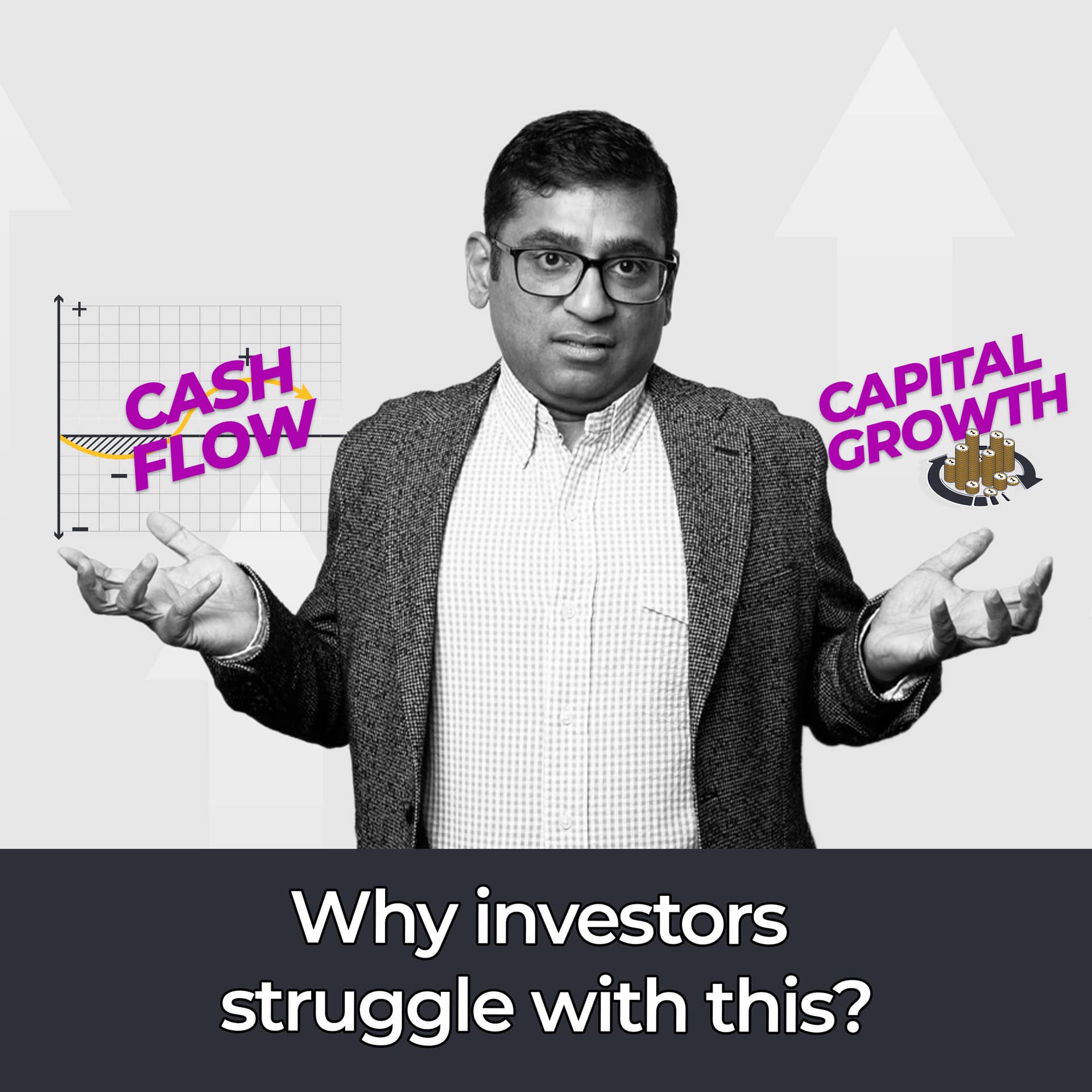
Yes, yeah, eight, nine grand negative in a per month. So he was like, oh, no, this is not something for me. And that's, that's perspectives, right? Two very, two very good friends, always together. And one of them was like, super excited, this property is going to give me two mil. He didn't even ask, What's my negative cash flow? He didn't even ask or anything. He said, All right, I am looking at, I'm looking at a two mill growth in, say, seven years. So I'm looking at maybe eight, nine, 10% 10% kind of a growth in the seven year period. And I'm willing to commit. So I'm happy he must be knowing his financial so he was in a happy space where the other guy was like, this, this two mill looks nice. It's very interesting. It's, it's wonderful, but not for me, you know, eight grand, nine grand. No, not for me. So this doesn't work for me. And it's, it's these perspectives, which, you know, which you give you insights on how people will value something, or people will look at something and say, Okay, this is my perspective about buying a property. That's my objective. About buying a property or buying an investment property, whether it's Airbnb or whether it's a normal property, I'm looking at something, and my objective becomes capital growth. And so high capital growth, right? What? So you meet so many people, Julius, what is a high capital growth for someone so which you see say, Okay, this is high because these guys are not, not bothered about cash flow. It just wants high capital
Julius
growth, high capital growth strategies, basically, for whom, those who can afford to have those type of assets. So basically, if you buy a property with an objective of to achieve something from that property, then it's a strategy where you're buying a property to get a good capital growth which can at least above pitting the inflation. So for our example, inflation is around three to 4% and if your property is not growing at that price, then that is something which is not great property.
Parag Dixit
So that's a good way to put that. So if my inflation is coming, say, 4% or three, 4% 5% in a in a year, and that's been consistently there. So unless I am growing by five or 6% I'm not, I'm not building wealth, right? I'm just just losing money. In fact,
Mudit
absolutely, I think 8% around that 9% I think 10 was in eight plus 9% I think that's what you would call that? Yeah, that's a decent capital growth property. I think somebody who's focusing on this strategy should be thinking about that kind of capital growth, because then only it starts making sense from a growth perspective. Otherwise, otherwise your money can make extra money somewhere else as well.
Parag Dixit
Absolutely right. So it's not the property which is important, it's the goal which becomes so important for a person. And that's where I think one of the positives of a high capital growth property, I think that's, that's, that's a good feature. When someone looks at high capital growth property, one of the key positives they're looking at is wealth building. So they're saying, I am going to get in this case, he said, I want, I'm looking at an 8% return out of this. So I'm looking at twice the inflation range. So it gives me a phenomenal chances to build wealth. It gives me maybe a positive flip on the opportunity cost. So I'm saying if I'm going to invest money in stocks, or if I'm going to put in ETFs, or if I'm going to put in some other property in some other area, I may get a normal growth of four, 5% or just reach the inflation. But here I am taking that positive flip, and I'm moving towards an opportunity cost, a positive opportunity cost, and I'm getting into a wealth building cycle, right? And that's what my that's what one of my great positives of having a phenomenal, clear focus on a high capital growth property,
Mudit
100% And I think that's that's how somebody who's focusing on capital growth, for them the market or the property, like you're saying, absolutely right. We see so many people every day that one property, it's not about a property is good or bad in itself. It's about whether it meets my objectives or not. And that's where a growth like this, somebody who's Targeting growth, it makes a lot more sense. Yeah, there are other advantages. I mean, for example, the tax benefits, the negative gearing, right? So if you're if your property is high on capital growth, you will still get tax benefit out of it, because if the cash, cash flow will probably not be as great, you'll be, they'll be negative, but at least you'll get something back in terms of the tax incentive from the government.
Parag Dixit
Absolutely, I think, I think the guys who focus on high Capital Growth Properties, and are very clearly looking at a good negative gearing benefit out of that, and that's a good capital growth profit position is that I want to take a high negative gearing benefit, phenomenal refund in the tax return, and also have a property growth
Julius
growing At a phenomenal pace as well. Another one is basically when you buy a high capital growth property, if it is growing at a good pace in 345, years down the line, you have a good amount of equity which has been generated by that property. So you can leverage that equity and you expand your portfolio. Yeah. So that is the additional benefit of the high capital growth property. So rather than just holding on one property which is not growing at at the right right pace, getting a property which is high capital growth which will give you good leverage about to expand your portfolio into meeting your objective as soon as possible.
Parag Dixit
Yeah, true. So financial leverage is one more positive which we are looking at to get a high capital growth property, and that's the that's the benefit, you know, which I get out of that, so this good positive, which I get out of that, that I can leverage that high growth, and because I've got an equity which is building every year, I can, if I'm looking at building a large portfolio, I can get more and more equity from there and buy some other assets. When that then what do I do with the assets? It's a different thing. But this property is allowing me to generate that bit, to use that leverage. And leverage is the most important thing when we are looking at building portfolios, so that we don't really put too much of money from our side. Is that correct?
Mudit
Absolutely correct without leverage, it becomes so I think one of the big differences we see across asset classes is when you're buying property, then you have the ability. One is, of course, leverage. And second is, if you're able to leverage money, and because of the capital growth, then you and if you're able to grow the cost of grow the cost of money and versus the cost of your the pace of your growth, if the pace of your growth is much higher than the cost of the money, then, then, then, that's what you're looking at as from a strategy point of view.
Parag Dixit
Yeah, absolutely right. So and it fits with if it fits with my goal, and if that kind of property is sitting with my goal, I'm loving it, and that's where I'm wanting to be. But it's also the other side as well. Right the flip side of me is that I am now looking at a constrained cash flow. Because I am. I've already moved into a stage where I've seen, okay, in this example, is I'm eight grand negative. That's very that's a good part that I'll get a refund when I'll file my tax and all that. But every month, I have to pay eight grand out of my net taxable income, right from my net income, which is coming into my bank account. And that negative is not easy for anybody to do that. So unless and until I have the holding capacity, until, unless I am able to afford that negative, it's, it's, it's a tough thing for me, tough market.
Mudit
But having said that, see 3 million prop, $3 million properties is not for everybody, right? Yeah, of course. So if you're looking at, I mean, just to compare numbers, if you're looking at a little later we let's talk about a smaller property, which is, let's say, 600 700 let's say 600 700k you will probably be not eight grands negative. That becomes just too difficult to imagine a scenario for most people. But if you probably will be still, let's say $1,000 $1,500 negative per month. Yeah, right. So if you're looking at a moderate average, today's investors average ticket size kind of thing, right? So, but yes, you are absolutely right that if you're chasing capital growth Now, not every property will have very high capital growth and very high rental yield. You there is always a trade off. So when you when your strategy is good capital growth, there will be a bit negative on the cash flow side, you will have to shell out a little more from your pocket every month. So if that clash, cash flow is not sustainable for you, then this strategy will not take you long term.
Parag Dixit
So I'm just curious now, that's the guy saying when he's looking at a full, clear focus on, I want a high capital growth, I don't care about any other variables, right? He really is foregoing the benefit, or he's the negative he's taking along with him is the cash flow, which he cannot afford to really, to really sustain. And he's he's saying, Okay, I am going in. I'm getting into trouble. He's not saying I'm getting into trouble, but he is at his level. So there, if and there is another investor, he will say that, okay, I can afford to. I really want to buy a high, good capital growth property. In a million dollar suburb, but for that million dollar suburb, if I am negative by $2,000 can I sustain that $2,000 for all this while the property looks nice, but I need to be able to sustain that negative $2,000 and if I can't, then, then it's a very it's a terrible strategy for me, correct?
Mudit
Will you because, because that cash flow can can put pressure on you to exit out of that property before you want it to. So understanding this, that a nick a high capital growth property, what is the cash flow going to be look like? It is very, very important for any investor before clearly saying that this is my strategy in your in your friend's case. So the guy who's getting very excited by this, he probably will have deeper pockets, or he has very high income earnings. So for him, it doesn't matter. But for the other person, other friend of yours,
Parag Dixit
it's a market risk as well. See, I'm assuming that in the seven years, it will become 2 million, more than 2 million, more than 2 million. But that's I'm assuming now my market risk is that something happened there. Some government stuff happened there. Some there was an infrastructure project, which everybody was hoping to come in. There's a train line. There's a high speed trade line is expected from Newcastle to Sydney. And there he was hoping that, obviously, I'm going to get a benefit out of it. But my but didn't happen or get got delayed. And instead of in seven years to get the 2 million gain. I'm now at the end of seven years, I'm already at a $300,000 gain. Now I've spent all this $300,000 already in the cash flow negative, which I was. So it's a catch 22 for me. And then, and that's where the market risk comes back to me. Then that brings to me also holding uncertainty, holding period uncertainty that How long will I really need to hold to actually get that fancy benefit, which I want, you know, I've heard people getting 100% jump in the property price, but do I get that?
Julius
Yeah, so that uncertainty is the biggest factor. Also, there is a short term opportunity loss as well. Yeah, in short term opportunity loss for an example, if I'm if I would have bought a property somewhere in Central Coast where the property market was not doing great from last four or five years, and then if I would have spent around $700,000 on property by now, that property will be around 808 50. But if I would have split those 500,000 $700,000 in two properties, and I would have bought one property, netted and Perth, then, in short spam, the return would have been phenomenal. Yeah, correct. So that short term opportunity cost is also very important because of the hope of getting into an area where, because of the market risk, if I'm investing somewhere where the return has not been where I could have invested, in markets where the return would have been extremely great, that that would have been lost. So that research is very important when we are doing all of these type of strategies.
Parag Dixit
That's true. And in fact, I would this good point which you put up. So when you are there, when you look, looking and listening to the pitch from someone who's saying that, okay, your three mill property is going to become 5,000,007 years. Now you're going by that pitch. If you've not really researched that one, whether that three mill is a good entry point, that's a different thing altogether. But what are the factors which are going to take me to a 5 million growth? If those factors are not sustaining what I want to do, then it's, it's, then I'm into a terrible loss, and that opportunity cost flips on the other side and tells me that I could have invested in some other area, and I would have grown in that same 80% but here I'm stuck, and my money is stuck, and I don't have
Mudit
anything else to do. Absolutely, I think there is no beating the kind of research you need to put in, the effort you need to put in there. You can't just so real estate agent, their job is to kind of sell the property ultimately, right? So sell a dream, and if you're just too caught up into that, and you're not putting your your time and effort and skill behind it to figure out that whether really is it going to grow that much, because market risk, when you talking about it, it could be, like you said, that it could be a infrastructure related, or it could be a larger also, there's something happens, some event happens right at a national level or a global level. So these are always market risks. But when you're thinking as a strategy, of course there are market risks. You have to the whole thing is that not taking any action is also an action. So you have to do a calculated risk and take, take. You have to take a point, ultimately, whether you go this way or that way, but you have to do some calculation, and based on your information and knowledge as of today, you have to take a call. Of course, we can't go back in time and change everything, but
Parag Dixit
it's always there. Yeah, but yeah, you're right. And, and this is something which is, I think, a hallmark of a typical these kind of properties are typically suitable for maybe a high income earner, someone who has high disposable income in with them, and they are able to take that inherent risk and able to take maybe play that Punt by saying, Okay, I have an back of the mind. I know I've got a disposable income available to me, of, say, 10. Grand. And I think this, this property, by the looks of it, and by the location and by this thing is a winner. So I want to put that here, and I'm fine. I'm fine to go all in, you know, I'm throwing the kitchen sink at it, and I know it's going to grow. And you say, Okay, if it doesn't grow by two mil, I can it can grow by 1.5 million. But it's a typical hallmark of a high income earner, someone who has high disposable income in front of them, right?
Julius
You're also you have a deep pockets, like you have lot of savings for in account. And in a case, if you can hold those properties for longer time, yeah, because of the market risk or because of the uncertainty, if something happened to market properties not growing at the pace which we are expecting, then probably you need to have that sustainable income. So unless you have that provision, then it's really difficult to hold this property for a longer time.
Mudit
Yeah, talk about it. Deeper pockets, inheritance, Mom and Dad bank, yeah. Or you made a big business earlier, and now you have a lot of money. So yes, absolutely right. You either have to have very high income, which is coming in every month, and you can manage the cash flow, or you need to have those mom and dad bank something backing you up, right? Otherwise, otherwise, a property like this, a capital growth strategy, only makes sense when you are either rich in either one of these two. Otherwise, it
Parag Dixit
becomes very difficult. I can also see a scenario. I deal with so many investors at all point of time. So I've seen investors who invested into great, high cash flow portfolio, and then now you suddenly sitting at a point where you find that I am at a positively geared portfolio, and that's adding to my tax, tax income, and I'm paying more tax now, so I haven't scope or have an opportunity to be able to invest into something which is high capital growth, because I'm now balancing my portfolio the other way and saying it is much more positive for me, and I bring it need to bring it down. So I'm saying, Okay, this is a good opportunity. I have four, whatever, $4,000 positive cash flow from my investment properties, and I can afford a $5,000 negative. So four, and this, this one's eight grand negative. I'm balancing it out and when that's another kind of category of investors which can really look at some pure, high capital growth properties. Absolutely.
Mudit
That's a good way of calculating what you can do and what you cannot. And then focusing on, if you are rich on cash flow, then you can afford to go bang on on capital growth a little bit more extra. You can take that risk. You can take that market risk. You can take but of course, again, we discussed right that research of what kind of property suits this is very, very critical here, whether you are coming from any of these scenarios, whether you have high income, or whether you have high savings with you, or you have a good portfolio already, of which is rich in cash flow. Finding that kind of property the research is critical. And that's where I think, Julius, you want to add some what kind of properties location. We hear it all the time, right location and the type of asset, of the type of asset.
Julius
So factor which we need to look at, like supply and demand parameters. So for an example, wherever the supply is lower and demand is higher, then we need to look for those type of locations where you can find those type of properties or the Another strategy would be like infrastructure related strategy. For example, when you look at the supply and demand type of strategy, we have witnessed the immense amount of growth from last five years in lot of states and the councils across Australia, like you look at the Perth, Adelaide, look at the Brisbane then major infrastructure events like the Sydney Airport. So when we see the airport infrastructure were announced since then, by now, the property prices have been doubled in the capital value. So those type of infrastructure changes, or if there is like zoning changes are happening into that particular area, so we can grab something which we can leverage upon. So if we, if you look at those type of infrastructure, then yes, then these are the type of the properties which you need to look at, the location. We have to look at where you can go and invest, and look at those strategies which will align with the capital growth strategies.
Parag Dixit
And then you kind of mitigate the market risk by saying, Okay, I'm going into a into a property where we expect that there's going to be a rezoning in the next couple of years. There is a council program which is coming up. There is an opportunity which is coming up, and that opportunity is going to bring across something better to me. So let me go and invest into this street, because this street is going to get rezoned into something else, into a high rise zone or something, and then, and I'm going to but the important bit to mitigate my risk is when the rezoning is done, I know when to exit. I It's really done, and now the infrastructure will come, and now it will take, say, 10 years, and I don't have a holding capacity for 10 years. I could have held it for three or four years, and that time I achieved my rezoning, and bang, I'm out. I'm out of that.
Mudit
Such an important point, such an important point. And a lot of people, when they're investing, they forget about what, when will I exit, right? So, yeah, so it's important to understand that, okay, I'm gonna buy it. Of course. You don't have a crystal ball. You don't know exactly why, when will what happened, but a clarity on that once this is done and it is a good time, you. Can't time the market perfectly and say, Okay, whenever it is the maximum, then only I will exit. Then it will you will probably cross it. And then you will realize, in hindsight, that I should have sold that time. So 100%
Parag Dixit
absolutely right. And this is, this is important, because when I I'm looking at an objective of saying, Okay, I I'm buying it because there's an infrastructure coming in there. I'm buying because there is a huge supply and demand difference, which is there, then I'm buying it because there is a rezoning, or these kind of opportunities are coming there, then I need to know that, okay, I've made my money. There would definitely be some more money on the table. But I want to get into some other area, because I'm looking at a high cat capital growth property, and a high capital growth property will always have a ceiling, with a with a holding period. And with this, I can't hold beyond it, or I don't want to hold beyond it. So you know when to exit out of these I I don't think so. I've met too many investors who have a perpetual Hold on a high capital growth property, unless your loans are so low that you you know, you paid it on something,
Mudit
you're right. And that's where the what we're talking about opportunity cost, right? So if this property that I bought has gone up by, let's say, three years back to back, 10% so it is 30, 33% already up. Now, if my I have to continuously keep also guessing that, or not guessing, but speculating and taking a summit research that if the growth is not going to be similar going forward. It's going to come down in the next few years. It's going to be, let's say, 4% 5% then if my opportunity cost is better put this money somewhere else. Then it's a good time to exit. Because if some other property and some other market is going to give you again, 10% growth or 8% growth, then you're better off probably taking out the money from here now and put it
Parag Dixit
somewhere else. It's tough for the guy who's going to now come in just, just imagine if you you had a property for this three mill or something, which we which we're talking about, and now I'm selling it at five Mills after seven years. What? What happens to the rental yield there? So I'm already talking of a lower rent need when I got into it, and now this is going to come in, is going to have even more deeper pockets. So maybe when these are high Capital Growth Properties, they they they are. They sometimes come along within some affordable suburbs, like, like what happened in Perth and what happened in Adelaide, that they were high, that when the boom cycle came, the capital growth grew like crazy. And if I was there, it's an affordable area and it's a good mix, but normally it doesn't happen when it's a good mix. But if you are there in a high capital growth property and you've exited out, I think that such kind of suburbs get more occupied by owner occupiers rather than by investors, because investors would find it tougher and tougher, but sophisticated investors can still be there or high, deep pocket investors can still be there. Who can, who can do? Do that, right?
Julius
Yeah, as they become a choice. Suburb, similarly, like I have my own example, I bought a property in Kellyville in 2019 Yeah, spend around $990,000 rented at around $1,000 a week. So precisely not but so my yield was around 4% Yeah, by now the growth is significantly higher. The latest valuation was around 1.9 million. And so capital growth, and if I calculate the annual capital growth is around eight to 9% but the rental yields are not significantly higher. So if someone the rental income is still 1000 to $1,100 so if the new investor would like to get into that market and buy that property from me, from for me, it's still sustainable, because yield is around three and up to
Parag Dixit
4% because calculate on your original price,
Julius
but when I'm looking at the new investor for them, it's only a 2.7% gross, yeah, and that's the classic example of, okay, if you want to get into the high capital growth investment, then timing in that market is very important, like I timed it, but that buck that if I look at the Kelly will, if I look at the type of the market. It is, type of the supply level, plus the affordability, plus the income, then the market will definitely go at least 15 to 20% in next two to three years.
Parag Dixit
So you're still holding on because you think the exit point is not come,
Julius
Yes, correct. So, so, so in that case, if someone want to get into that market, yeah, they'll get a capital growth, but the amount of rental yield, or the amount of sustainable income they have to be from their pockets, is significantly higher, because the dollar value is big.
Parag Dixit
Correct. Now, that's why I think, if I'm not wrong, Kelly will is more 85 86% owner occupy. That's the nature of the market, which becoming, but still, there are 16% investors in there who would be in this deep pocket or high income in all these categories, who are able to sustain that property and are able to enjoy the capital growth which will come along with it. And when they are able to enjoy the capital growth which come along with it, they are not really focused on the holding cost or or they. They're really not. They may be focused. Maybe they have put they are a very lower LVR, or something which matches your LVR. But they, they're looking at, they're saying, okay, cash flow is not a concern for me. But again, so, you know that's, that's one example which you give. But there are other side of examples as well, right, where people buy properties which are high cash flow, you know, the other extreme. So we're talking of this extreme where there's these guys who says cash flow, are not bothered, but there are other extreme as well, right? Where people say, I don't want to look at I don't want to spend $1 from my pocket. I want a property which is positively geared, which gives me money into my account, right? And that's where I am now looking at a highly, positively geared property, sorry, not a highly cash flow oriented property, which is going to give me money to me, right? That's, that's the other extreme
Mudit
of the strategy. So, like we were saying that you can't get everything from the same property, it is very difficult. You have to balance it right so, so I think people who focus on cash flow, so I generally, my observation has been that if you're targeting something like a 6% 7% plus kind of rental yield, if that's something you're getting, then you get into the zone of good cash flows. You probably will get maybe some positive cash flow out of it, or maybe it might be just zero net net balance, but you will not, you will not be large negative from your pocket every month. And that's what this strategy is about, that you focus on making sure that there's no, not much net negative from your pocket. But then you're saying, okay, I'm okay with capital growth. I'm not too fussed about it, even if it grows by 5% it's of course, I mean, ideally it should beat inflation, because otherwise it's going to be negative, but it doesn't grow by 8% 10% I'm okay with that, but I'm able to sustain that property, because I'm aiming for a sustainable property. My cash flow allows for that, and I'm not looking for large capital growth right now.
Parag Dixit
That makes sense. Yeah, that makes sense. Definitely. That makes sense and and we definitely sure so many times come across such clients and such people in our businesses, the who say, I want a property like that, and I'm looking at something exactly like that, right?
Julius
So many. There are so many instances when I talk to client. In fact, I worked with a client called John recently where I bought him a property. The objective was just to get a cash flow, because, according to his income, he can't sustain lot of negative gearing with his interest rate. So we picked up a property in original Victoria that is around $330,000 and then rental income was very close to 520 so on an average, he's he'll be getting around 120 bucks positive in his account. So in that case, that property is suiting his criteria, because his incomes doesn't support him to go and have contribute lot of money for the property. So yeah. So we often get this type of investors where we intercede with them, we understand the requirement, and we try to help them in this type of scenarios,
Parag Dixit
Yeah, correct. That's the other extreme right, high cash flow property which is going to give me positive income into my account. I this not even $1 which I spent 7% kind of rental. It's definitely matches there, you know, with a five and a half 6% rental, or interest rates right now, maybe one odd percent. So you're looking at a 7% plus 8% plus kind of a rental yield correct, which you're getting from these properties, and they give you that benefit of completely keeping your way. So when my other friend ash says that I'm looking at my cash flow, and I don't want to say, spend $1 from my pocket, then I'm looking at the other end of the spectrum where I'm saying I don't care what, what it is all about. I just need to have, I should not impact my lifestyle be clearly, be there right now.
Mudit
And these are people who clearly understand what the cash flow looks like. They understand that, okay, there are, because these are important things to know. There is interest cost, then there will be, there might be some property maintenance. There will be a property manager. There will might be council rates, insurance, if it's startup property, they might be strata. So you have to factor in all these factors. See what is the net income coming from the from the rental income. Subtract all the expenses that you have, and look at the net
Parag Dixit
cash flow. You basically want less out of pocket expenses. So you looking at you looking at you. Don't want your pocket to be impacted in any way whatsoever. I don't want to spend any money from here. And it's nice as well, because see, when I'm invested into a property like this, when I haven't, when I'm holding a property like this, I am if I want to sell, if I have any trouble, you know, if I, if I'm finding that it's, it's uncomfortable, I just don't want to be in the investment or anything. Circumstances change. I just, it's pretty easy for me to get out of it, because there'll be investors who will be keen to come into it, right? Because it's easy to hold that kind of property. So the kind of people who want to enter would be the for them, it will be easy. As well, versus the other one, the high capital growth one here, I'm finding the ease of exit being much, much quicker, maybe,
Mudit
yeah, ease of getting investors, somebody else to buy in, plus ease of renting it out. It's already probably rented out, and you don't have to worry too much about that, whether it will be vacant or not. So when, when the rental yield is high, if you're choosing correctly in those areas, when the property is already rented out, there's enough demand for it, so that stress of whether I'll it will be vacant, and how do I pay from my pocket? That goes away.
Parag Dixit
It's my immediate rental. Yeah, correct. It is, right and it I think, as a mortgage broker, I know when you have a highly, positively geared, sorry, positively geared property with a great cash flow coming in, with a high cash flow coming in, I know that for me to get a loan will be easier, correct? Because I don't, I don't get too much impacted on my borrowing capacity. It seems it's in my it brings me to a better situation, a better circumstances, to be able to afford that property and hold that property and buy that property, right?
Mudit
So properties like this will add, if not add, but they will keep your borrowing capacity better, and it becomes easy for you to build further if you're looking to build further on the portfolio
Parag Dixit
and such such ones like I remembered, but not remember. I think it's common knowledge. If you look at Perth, which you were just talking about, that's what happened in Perth. It was a high cash flow state. And there was so much happening maybe three years ago that there was property was not rising for eight to 10 years, something. It was a latent kind of a city. Not much happening. Everybody was saying it's doomed, post covid. I don't know what happened to it. There's a rocket which came out there, or there's some kind of a thing happened, and people just started investing, because high cash flow, easy to hold on. And such suburbs which are high cash flow start booming, then you are into an affordable high capital growth.
Julius
Same thing happened in Brisbane as well. So similarly in Logan Council, when you look at those areas, they were more affordable, the rental incomes were higher. Lot of investors were investing over there, and over the course of time, they were gentrified. Due to the gentrification, suddenly there was good affordability, good type of population was started moving there, and then they have witnessed immense amount of capital growth. So that kind of scenario is pretty general when you go towards the suburbs, where you can actually aim for a high cash flow, but you can come out with the good capital growth.
Parag Dixit
Yeah, but obviously the circumstances should suit that that suburb or the area of the town will have a high capital growth. But eventually, for the biggest positive for me is that if one obviously I'm able to hold on to it. But the more important thing is if I'm lucky, or if I have done my research right, and I'm holding on to a high cap cash flow suburb and this and the gentrification and the income diversity and the income earning capabilities and the all that stuff changes and or something government does changes. Suddenly, I'm looking at affordable, high cash flow property, which is also now growing, and that brings a massive jump into it, right, correct.
Mudit
And like you rightly said, we have seen markets like that, where it has happened in lot of areas, especially in the last few years.
Parag Dixit
Yeah, and these are these, these kind of, the kind of people who would really invest, obviously, I'm not hoping for a capital growth, but the kind of people who would really invest into properties like this would be people who are very clear that I have a limited cash flow, and I either I have a limited cash flow and I don't want to turn my budget around too much, or I don't want to get into a situation where I have an impact on my cash flow. So I'm saying, Okay, I want to have my choices of my life. I want to lead my life in my own term. I don't want it to get impacted at all. So I but I want to invest. So let me invest into a suburb which is a high cash flow suburb, right?
Julius
Yeah, that's correct. So there are other examples, like if I am more towards the high capital growth portfolio strategy, and in a case if, suppose, if I would like to get so I have, sometimes I have to get a properties which can sustain my portfolio. So I have to get a properties which will have a good cash flow so to balance my portfolio. So these are the other examples of like,
Parag Dixit
yeah, so I'm already a sophisticated investor. I'm already invested into high capital growth properties, but I want to de risk myself, and I say, Okay, now let me balance my portfolio off and get a high cash flow property. And that's also another type of investors which may be looking at entering into a pure, high cash flow property as well. Or maybe people with seasonal income, or who are looking at very seasonality or short term kind of an investment, they would also be very keen on investing into a high cash flow areas where they they are fine that this is this, this is going to be long term for me, and I'm not going to get impacted by that at all, right, correct.
Mudit
So limited cash flow or, I think these are some, some very suitable for people who are in one of these scenarios. And. We often come across people who are lifestyle is very, very like it strikes you clearly that, okay, this is my lifestyle. I don't want to compromise on it. I will buy something, what doesn't, which doesn't compromise,
Parag Dixit
or maybe I'm impacted with my borrowing capacity, and I don't even want to go that way. So I have my limited borrowing capacity, but if I get into something which is going to have a higher capital growth, I am going growth, I am going to get stuck. So I I say, Okay, I'll just keep to my borrowing capacity and get into a suburb, or get into an area, or get into a property which is going to give me a phenomenal cash flow. And I sit tight, and I'm happy because I am now being able to manage my other part of the portfolio as well, or my maybe I have a owner occupied which is draining on my income, and I can feed that owner occupied from this as well. That's another tax strategy which people use. By using that to reduce your owner occupied debt. When you're having a high cash flow property, it helps you pay off your mortgage faster.
Mudit
In fact, I've come across another type of people there, like a bit a bit more on the risk averse side. So they are lot of people, and they have good incomes, they can afford, they have the lifestyle to and they can still manage, and they have deep pocket, but they're like, I don't want to, I think the market risk is just too high, and they just whatever is happening. I still believe in a lot of, let's say, Doomsday theories, and I don't want to take the risk. I don't know whether capital growth will happen or not, so I will still want to go and I don't want to take that risk, as simple as that, yeah, I can afford it. I have the money, and I know that it may not grow or grow, because I don't. I'm not certain about it. I don't want to take that risk as simple as that. I will rather rely on what money I'm getting today. So rental income is is good enough for me. Who knows the future?
Parag Dixit
I want the present predict? Yeah, absolutely right. No, that's that's true. But then you lose out a lot as well, right? So you lose out on on the market. You lose out on the capital growth, which is happening in the market, and you're willing to give that up, but that's a negative outcome. I mean, you're looking at a pure cash flow thing that you have a there. You have a good chances of losing out on opportunities. You have a good chance of losing out on a great wealth building and a wealth creation, which can happen for you and you, and it impacts you in some way that that okay, I am as an industry, that's my big negative. When I'm looking at a pure cash flow thing that I have, my wealth building doesn't happen, but it may, obviously there's an asset which is now somebody is paying off my asset for me as an investor. But why don't I lose out on that wealth building strategy and lose out on opportunity costs as well, where I could have grown my money if I could have afforded to be there, right?
Mudit
100% there. So I think people who want to adopt this strategy, I think or go for this, I mean that that's the clarity they need to have when they're focusing on this that okay, I'm, I'm willing to compromise on the kind of growth that I can I could have gotten by focusing on this cash flow so but then again, we know of people, it's always that, oh, my friend, my friend, bought something, and it had gone up by 500k in five years, and my property is still sitting at the same price. So I lost on that. That is there. So because, see, it is also difficult to predict that where's the market gonna be. So that's a risk you have to take. If you're keen, keenly focused on managing your cash flow as of now, you have to be okay with that. Okay. I may lose opportunities. There's an opportunity cost. I could have put this 100k which have become, which could have become 300k but it didn't become, but I am able to manage, and I made only 20k from the cash flow in the in those years. But I'm okay with that. I'm at peace with that.
Parag Dixit
I'm peace with my barbecue conversations that I don't want to say I grew 100k
Julius
or other risk is like, you go towards the suburbs where, like, they are, like, very low cost, affordable properties. But in that area, the tenant quality is sometimes bad.
Parag Dixit
That's the worst combination you can get into, right when you're looking at a high cash flow. And then you start going into very low value properties because they are having high cash flow, yes, proportionately. But then you get into the worst tenant category, and then you're into a mess, right?
Julius
You are into mess. Tenant will go and default. They stop paying. Then you have to pay it
Mudit
from your pocket, I think, more than the financial because, okay, it's a few $100 maybe $1,000 it's a lot of stress on your mind, right? If the tenant is not keeping your property clean or not paying for it, then you go through that trauma. It's and in a lot of states, the laws are not so friendly for the owners, and a lot of states have more friendly towards the tenants. And what do you do? Are you stuck? Is that
Julius
situation could be terrible, because it's very hard to vacate those tenants as well sometime. So these are all always the negatives, or you can say the risk associated with the high cash flow properties. Another thing is like when you buy properties in super regional areas, so cost of maintenance of that property is extremely higher because they are super regional, your insurance cost is always higher, plus the when you look at the council rates, because amount of property in that particular Council is a limit. It. So your entire expenses of the council will be divided into the number of properties, and then your expenses are higher because your situation is too remote that you council rates are always very high, and then they keep on growing so they like progress towards your insurance payment. There is more progression on your council rates bad quality, and it could be a potential risk for your entire cash flow.
Mudit
So you're saying that even if I'm getting 8% rental yield, but net, I might be getting just 5% because there are so many relatively although these costs may be just 1% for normal property, but because of my choice of a certain area or a kind of property, these could be much higher than that, and my net rental yield goes down, that's a potential risk.
Parag Dixit
Oh, that's a big fall. That's a big red flag there. So if then you just you saw actually, so we can't look at gross rent. Sometimes the gross rent hides a true story into it. Yes, the 7% or the 8% or the 10% gross rental yields, which are which look very nice to read, they hide the fact that below that your net trends, which you're going to get are going to be terrible and that it's going to be stressful on you, and you're back to a situation where you're holding a subpar asset, or you're holding a low value asset, which is not growing, and you are having low rental return net, Low rental returns, or occasional high costs, which bring that no low rental to lower topics and lower points. And then you are into then you're back to where you were, which you wanted to avoid. Yeah.
Mudit
And one is that these costs could be higher. The second is, I've seen where, where you're you're not too sure about what the rental, what, the occupancy is going to be like. Maybe you bought a property into an area where there's a lot of supply coming and suddenly you see that your property is vacant for longer than what you were expecting. And that doesn't go well, because now you're sitting three months without your property being rented out. And you were expecting 8% rental yield, but it automatically is dropped to 5% now, just because you bought in an area without good research, and you bought property with a higher supply coming in,
Julius
also the management cost is extremely high too for those properties, because you have very limited resources over there to manage your property. So that could be the potential risk.
Parag Dixit
And, yeah, that's a huge risk. And I think mining towns and all these areas where such kind of properties are prevalent and people jump in. There are an example where you can, you can skew yourself too much into the riskier side and get into, get into an issue with such ones. There are more such segments, right? There are more such areas where you know, regional towns, super regional towns, where you find these properties, but they are, they are something which you will, you will not want to go there. But sometimes affordability comes through. Where affordability is hiding behind it, the cost, which is it, which brings along with, with it, right? Yeah.
Julius
So when you look for those type of properties, is affordability is come in place when you buying the property, but exactly when you're talking about the mining towns, yes, when the mining if there is a good mining project or good energy project like Southeast Queensland, or there are lot of mining project across like Queensland Perth regional you need to know when to exit. So when, when they are, when they are in boom that time you have extremely high rental return, as well as sometime you can achieve a good capital growth because of the higher return return. But in a case, if you don't know when to exit, and if something happens to those mines of this project finishes, then your property can be vacant for a longer time. You will have very long vacancies. So that they are the other, they are the potentially very high risk.
Parag Dixit
And these are, and I've seen that in the past, and we've all seen that in the past, that these properties have prices which go up as fast, and they come down even faster. Yes, because as soon as the cash rent has gone down or the net rent has gone down, or the gross rent has gone down, investors just flee, right? And there's no one who's wanting to buy your property. I've heard bad stories of a half a million property becoming $100,000 property and all this
Mudit
overnight, overnight, these things happen, and there have been so many stories behind it. So I think absolutely right, when we're talking about cash flows and as a strategy, it's important to look at that you're not going on, what is the risk you're willing to take, how much you are willing to take in order to make sure that your cash flow is sustainable? Because overnight, if your property, you are getting, you're getting 10% rented, right? That's good. But if that's the risk you're talking about the mining towns, kind of certain places where it crashes overnight to 100k you've lost 400k from half a million property. All that you made in rental does not justify it at all.
Julius
So because the entire hypothesis of buying those type of properties is around the rental yields, and then those rental yields are coming, because you have this project. So if you don't know when to exit from those properties, then it is not aligning with that entire hypothesis when those projects are running out.
Parag Dixit
Absolutely So again, like we spoke, when we are talking of, how do you find a high capital growth property, which which should suit you? And then. It requires that research coming in. Even here, a research is required, right? When you're looking at high cash flow property, you can't go blind and look at an advertisement which says it's a 10% rental yield which is going to come, or an 8% rental yield is going to come. I've heard of towns very, very remote towns where people have gone and bought properties in, you know, in in their trusts, in their normal names, in their Supers, in their SMSFs, and all that stuff people have done. But they are some remote, remote, remote areas, and then you don't know when to exit. You don't know what to do with it. And then you are so
Julius
you should follow certain criteria when you are looking for those type of properties, like, when you do the research, look at what kind of population, like, what's the size of the population of that type that so it will define the risk. Also look at the kind of employment in that particular region. Look for demand and supply indicators. And then type of property does matters the most. Yeah, so look at the type of property if, suppose, if you're getting into a good regional town center where around 15, 20,000 people are living, we know that, okay, not so many investors over there. That's a time when you're entering to that property, try to look into the duplexes or block of units, or look for house and grannies where you can have a sustainable income. So doing that proper research about where to buy, what kind of property to buy, how to mitigate the risk, and what kind of asset you need to select, that will make the entire hypothesis around whether, what kind of property where to buy in high cash flow environment,
Parag Dixit
yeah, and, and they can be good options as well. You don't need to take undue risk. You know, there are types, some types of properties which are available in normal areas as well. I should not say the other ones are not normal, but in a better areas as well, where you can buy properties which are high cash flow. So you can look at, you know, you can look at a duplex, or you can look at a house in a granny, and you can look at these properties which are going to be return, giving me good yields, good, high cash flows, good, high, positive yields, and I'm able to
Mudit
quality assets. Yeah, you basically, yeah, you, you don't need to take unnecessary risk just because of a much higher cash flow. But what you can do is you can manage a decent cash flow by selecting a right kind of property in a less risky market. That's a good strategy for for many people who, who, who are not in deep into research and not deep into analysis, but at least from a broader point of view, that can help select a better quality of asset
Parag Dixit
100% and that's the quality of asset which we are all wanting to do. And that's, that's how the objective gets defined for me. So for me, my objective is that, okay, I am wanting to have a high cash flow. But that doesn't mean that I throw caution to the winds and I select whatever is coming my way and whatever is there it just pick that up, right?
Mudit
Yeah, so I think again, we speaking about it, that hope you can't rely just on hope that I hope that this will happen, but yes, research a calculated risk, understanding your financials, understanding your own objective. And how is this property suitable, whether it's a capital growth or cash flow, whichever strategy you want to take, but you can't just hope to have things to happen for you. You have to put in that effort and take help if needed, whatever. Study more about it, do some research, and then figure out which one end and when we're talking about these two extremes, one is the high capital growth versus high cash flow, then there's a balanced approach where you're talking about hybrid of looking at both understanding good capital growth, understanding good cash flow, and taking a balanced approach where you're saying, Okay, I'm not going extreme on just taking high risk and going very, very high on capital growth, or going only thinking about capital growth, only about cash flow, but balancing it and figuring out that medium which is more manageable also and gives me decent return as well.
Parag Dixit
Yeah, I think that's, that's where most of the investors, like us, you know, most of the common investors, who would think, Okay, let me balance it out. Okay? I have, I have, I want to have a good capital growth, but I am happy with four, 5% 6% 5% annual growth. That's fine with me, till I am able to be $1,000 negative. So which is what I can afford. I can't go beyond $1,000 negative, and that's what we do. You know, when you talk to an investor, I want to invest. Okay, the first question is, how much negative Are you able to afford? Can you afford a 500 bucks negative, $1,000 negative in a month, $2,000 negative in a month. That starts defining what kind of asset you can go, or which area you can go, or what suburbs you can go, what states you can go at some point of time. It can also help you define what is my strategy of making an investment portfolio? And that's where I say, okay, when you're looking at $1,000 negative, and you're looking at an asset which is, say, 500 $600,000 then you're looking at a cash flow which is, or capital growth which is not 8% boss, it's going to come back to 5% Thing, right? So you need to mellow down that. But that's what most of our average investors are sitting that's the space
Julius
they are at. Yeah, it's upon the objectives. When we sit with the investor, we ask for the objective, and then, according to the objective, we build that strategy. So like, the lot of investors would like to get into one or two properties in the entire portfolio, yeah? For them, these hybrid strategies, like, okay, I can get you two assets with worth of four to 5% capital growth, and then your rental yield will be very close to four to 5% also. So for them, it will be very easy to hold those type of properties, and they can have a moderate capital growth across over the period of time. So they are investors where, okay, they are high capital growth focused. They would like to build at least seven to eight properties in their entire portfolio, then the objective would be having more properties in their entire portfolio, so equity extraction time would be faster. So during that time, yes, we can look for, okay, one with one property with very good, high capital growth, and then if you have multiple properties of those sort then to balance that the entire portfolio, then we could add few properties of good, selected properties, well researched areas about from the high cash flow areas. So like these are two potential scenario which often look at in when we sit with the client.
Parag Dixit
That's like, you know, you can have a good bouquet of flowers, you know, couple of ones like this, couple of them roses, couple of then the others, and then you make a good bunch out of it, and it can fit. It can be good. It smells good. It's a sustainable one. It doesn't smell rotten. You know,
Mudit
that's a good example. And and doing this, you also de risk yourself. You are diversify. I think that's that's that can add value to your portfolio. It doesn't matter whether you have a small one or big one, just one property, one property to invest, or 10 properties to invest. There are investors across but a balanced approach helps you, like you said that, yeah, it smells good, so you feel good that you have invested in a property you there was an objective of making some money out of it, and being able to balance you, able to manage your lifestyle, along with getting some growth around it. And it's not necessary that you will get everything in the same property. Maybe for people who have invested in high capital growth properties already, and now they're facing the pinch of, oh, the borrowing capacity is down, or we are too negative. At that point of time, you may choose to invest in a property which is better on the cash flow, so that you get that balance back and you're able to still invest if you want to, but you may not get as good capital growth as the other two properties, but you are able to get cash flow out of it, which is helping you build manage your portfolio existing one much better.
Parag Dixit
It gives you flexibility. It gives me so much of the breathing space. It allows me to do what I want to do and whatever I and maybe I find another opportunity which I could invest into, which can be a good capital growth or a good cash flow one, because I'm sitting at such a balanced portfolio, I have already de risked myself. I have opened myself to looking at more things in the future, not only property, maybe something else, you know, maybe you can you can go for a holiday. You can enjoy your life, you know. But it allows you to de risk your own personal self from it, and then that's, that's the best part of it is sustainable portfolio is what you get out of a balanced approach. The sustainability of a portfolio is so key to building a long term portfolio. That's that that's where the hybrid investor is looking to what they are looking to achieve, right, to get into that bit, right? Yeah.
Julius
And then it has, it will help you to sustain your borrowing capacity as well, because you are not either going too negative. And then, if the cash flow is sustained, and then if you are able to hold those portfolio for longer time, then, and if it is improving your borrowing capacity, then, if required, then you can add more assets in your portfolio, so that will help you to extend your portfolio.
Parag Dixit
And that's where I think that diversified portfolio approach comes into play, where I'm saying, Okay, I will have a mix, and I will have something sustainable. I will have something which doesn't allow me to be too much of a risky proposition. And that's where I think, if I when we meet the investors, I think 70, 80% of invest, maybe even higher, would be sitting in this category where they want to keep it less risky. They want to not be on one side of the risk altogether. They would want to have something which is a much better approach for them, which is a much easier thing for them you, because in the end, you need to live your lives, right? You can't just invest in you can't feed on properties. You have to live, you have to enjoy your life as well, 100% right?
Mudit
And so I think, like we're saying very clearly, I think there are three, three broad strategies we're talking about. One is that you focusing on capital growth and you're choosing your properties first is to define what you're what you're looking for, what your objective is, what your what your risk taking appetite is, right? So based on that, you say, Okay, I'm going high on capital growth. I go for it, or I go for cash flow. And I'm I'm not. Am okay to compromise on the kind of growth I could have gotten. Or third, we are saying that, yes, I don't want to go extreme. I hope I want to be able to manage my lifestyle, along with get some decent growth. And these are suitable for different types of people, different kinds of goals, different kinds of current financials, what kind of savings they have, what kind of incomes they have, very, very different.
Parag Dixit
Yeah, true. And that also allows me to have a much larger area where I can invest in I would find that maybe 60% of or 70% or maybe even higher percentage of suburbs will fit into this category where I can build a more balanced approach. I don't need to go crazy about finding something which is really, really out. It's an outlier. You know, I need to be normal. I need to be most of the suburbs will fit in there, correct? Yeah, there are
Julius
a lot of suburbs which are often fit into that criteria. Probably, when you look back five years ago, most of the western city was part of that kind of properties. Similarly, across Australia, if you look properly, getting a decent rental yield of four to 5% with moderate amount of growth, around four to 5% a year, it's not tough. It's not tough.
Parag Dixit
It's not tough. That's right. I think now, you know, I think we've spoken at length about like, what did this nicely? Put up three clear strategies, and, and to, just to maybe summarize it, I think a high capital growth strategy helps you, definitely helps you build long term wealth like that's the key for wealth creation that you have proud strategy, which is depend, which is clearly focused towards a high growth property, right? And versus, if you're looking at a high cash flow property, you are looking at something which is sustainable, which is giving me income, which is which it drives sustainability to me. It allows me to lead my life like that. But I think the best is to have a balanced approach. When you're looking at a portfolio level. When you say, Okay, I want, even if you have two properties, three properties of four or five, or maybe those fancy numbers of 10, 2030s, or not, eventually you have to have it sustainable. And I think hybrid gives us that more sustainable approach towards having a good, balanced approach, in a long term approach for myself to have a great investment portfolio, right?
Mudit
Exactly, absolutely. So again, like so, depending on what my objectives are, I think most important, first thing is to I know it is tough to define the goals and objectives. Long term, especially immediate, is simpler to define. But if you can see through a little bit more that what you're looking for building. And second, what your current context is, what is your financial look like, both from your savings point of view, and also your incomes. And are you looking Are you are you expecting any changes in future, coming future in your financials? You have to think about some of those, because you can't just do everything based on today. Things are changing. It's a dynamic market. Not only your financial change, there are market is also changing. Interest rates are changing. The economy is changing, and inflation is changing. So there are some things which are changing in the market. So you have to have some kind of view on that. Read more about it, do research whatever it takes. But based on that, you take a call, Okay, which of the approaches you want to take? And you can go either way. It's this. There's no right wrong here. It's more about what suits you, and the property is ultimately the last thing on this, which is the most important thing, but it derives from what your goal is, what your strategy is, what your risk taking, appetite is, what your financials allow. Where do you want to go? What's the part towards it? And then which property, where? What kind of assets suits that the best.
Parag Dixit
Absolutely, I think that's a good that's a good way to put it up. I think, I think it can summarize it by saying, luck can't be my strategy,
Julius
my strategy, right? Yeah, research. Do proper research. If your financial allows you to hold property for a longer time with if you have deep pockets, then definitely look for a high capital growth if financial doesn't allow, but if you still want to get into the property market, because over the period of time, your property market will perform and you will have a long term growth, and yet you have a sustainable portfolio, then look for high cash flow properties. In a case, if you want to do a balance, and if you want to make a sustainable property portfolio with around 718 properties to build a generational wealth, then suggestion would be, look into the hybrid portfolio.
Parag Dixit
Absolutely right. No, that's good, good session, guys. And I think thank you very much. It's a, it's a fantastic discussion we've had and fantastic viewpoints we've heard from each other. It's a, it's a brilliant way of putting up high what I can look at a high capital growth property or a high cash flow property, and in fact, it makes so much sense to be a bit more balanced into this and have a more sustainable portfolio. But that's objectives. People choose objectives, and it has to be driven by objectives. It has to be driven by what I would want to achieve and what my objectives are. Thank you very much, boys, thank you so much for joining in. Awesome.
Mudit
Good, good, good chat today. Guys. Absolutely, thank you. Bye, don't.